Leave Your Message
Choosing the right Galvalume Steel Coil begins with evidence, not a supplier’s broad promise. The World Steel Association reported global crude steel production of approximately 1.89 billion tonnes in 2023. This scale reflects steel’s continuing role in construction, manufacturing, and infrastructure. However, production volume does not guarantee suitable coil performance. Grade, coating mass, surface quality, and traceability still decide the outcome.
Galvalume typically uses an aluminum-zinc coating, commonly specified as 55% aluminum, with silicon added to support coating stability. ASTM A792/A792M provides an important reference for product requirements, including coating designations and mechanical properties. In practice, buyers should compare the technical datasheet with the inspection certificate. Check thickness tolerance, yield strength, tensile strength, elongation, coil weight, and coating mass. Small differences matter. A thin roof panel can expose defects quickly.
The IEA’s Iron and Steel Technology Roadmap identifies steel production as a major industrial emissions source, making material efficiency and longer service life increasingly important. The USGS Mineral Commodity Summaries also tracks zinc and aluminum supply conditions, which can influence coating costs and availability. These reports offer useful context, but they do not select a coil for you. There is no perfect coil. A product suited to dry inland roofing may fail expectations in coastal air, humid storage, or aggressive industrial environments. Consider the end use, forming radius, paint system, transport distance, and local climate before comparing prices. I have seen specifications look excellent on paper yet prove inconvenient during roll forming. A stronger selection process combines laboratory data, supplier experience, independent inspection, and realistic application testing.
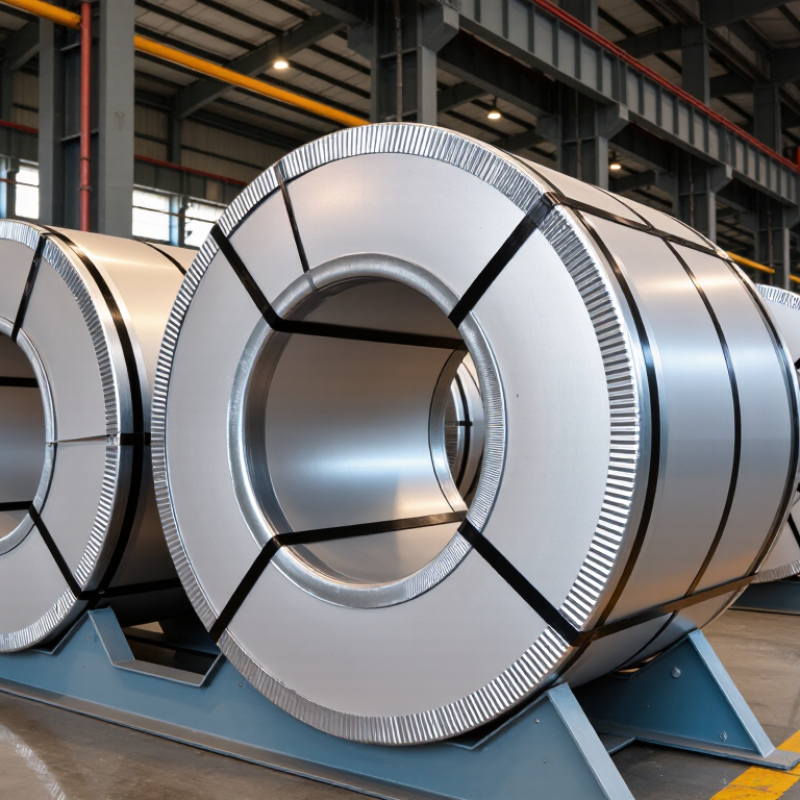
How to Choose the Best Galvalume Steel Coil
Understanding Galvalume Steel Coil Composition and Performance
When I evaluate Galvalume steel coil, I start with its coating chemistry. The steel substrate provides strength and structural support. The coating commonly contains about 55% aluminum, 43.4% zinc, and 1.6% silicon by weight. Composition matters. Aluminum creates a stable barrier against moisture and oxygen. Zinc offers limited sacrificial protection when small areas become exposed. Silicon helps control the coating’s reaction with the steel during hot-dip processing. Actual percentages can vary by specification, so buyers should verify mill certificates and applicable standards.
Galvalume performs well on roofs, wall panels, and other outdoor components. Its aluminum-rich surface reflects heat and slows general corrosion. However, it is not perfect. Cut edges may need careful detailing because edge protection differs from conventional galvanized steel. Sharp forming can also damage the coating’s surface. I have seen minor bends become early corrosion points when fabrication pressure was poorly controlled. That experience is easy to overlook. Storage matters too; trapped moisture can create dark stains before installation.
A reliable selection process checks coating mass, base-metal thickness, yield strength, elongation, and coating adhesion. AZ150 is a common reference, but the correct coating level depends on exposure and service life expectations. Coastal air, industrial pollution, and frequent condensation require closer review. Ask for test results, inspection records, and dimensional tolerances. A bright surface is useful, but it does not prove long-term performance. Engineers should compare laboratory data with the real site environment.
| Category | Key Dimension | Typical Data or Range | Selection Guidance |
|---|---|---|---|
| Composition | Aluminum content in coating | Approximately 55% by coating weight | The aluminum-rich coating structure provides strong barrier protection and helps slow corrosion on exposed surfaces. |
| Composition | Zinc content in coating | Approximately 43.4% by coating weight | Zinc contributes sacrificial protection, especially at cut edges and minor surface scratches. |
| Composition | Silicon content in coating | Approximately 1.6% by coating weight | Silicon helps control the reaction between the molten coating and the steel substrate during production. |
| Coating | Coating mass | Commonly specified from about 30 to 180 g/m² total for both sides | Choose a higher coating mass for outdoor exposure, industrial atmospheres, or longer service-life expectations. Confirm the applicable standard before ordering. |
| Coating | Coating appearance | Silver-gray metallic surface; regular or minimized spangle options may be available | Select the surface appearance according to architectural, roofing, appliance, or general fabrication requirements. |
| Substrate | Steel grade and strength | Commercial, forming, structural, and high-strength grades are available; mechanical values depend on the selected standard | Use forming grades for bending and roll forming. Use structural or high-strength grades when load capacity is more important than maximum formability. |
| Substrate | Nominal thickness | Commonly about 0.20–2.00 mm, depending on product application and mill capability | Choose thickness according to span, stiffness, forming requirements, fastening method, and applicable design calculations. |
| Substrate | Typical coil width | Often approximately 600–1,250 mm; wider or narrower sizes may be produced to order | Match the width to the slitting plan, roll-forming line, panel profile, and allowable material waste. |
| Performance | High-temperature resistance | Generally suitable for continuous service around 315°C, with higher short-term exposure possible depending on design | Galvalume is often selected for roofing, cladding, exhaust components, and equipment exposed to elevated temperatures. Verify the exact temperature cycle and atmosphere. |
| Performance | Atmospheric corrosion resistance | Typically superior to ordinary zinc-coated steel in many dry and moderately humid outdoor environments | It is a strong choice for roofs, wall panels, and general outdoor applications, but the environment must be assessed before specification. |
| Performance | Cut-edge protection | Zinc provides sacrificial protection, while the aluminum-rich surface forms a durable barrier layer | Protect cut edges and penetrations where the product will be exposed to persistent moisture, salt spray, or aggressive chemicals. |
| Performance | Formability | Good for roll forming and moderate bending when the correct steel grade and bend radius are selected | Avoid excessively tight bends because the coating may crack or flake. Follow the minimum bend radius recommended for the selected grade and thickness. |
| Performance | Paintability | Suitable for pre-painting or post-painting when the surface is correctly cleaned and prepared | Use a compatible pretreatment and primer system. Confirm paint adhesion and curing requirements with the coating supplier. |
| Environment | Recommended exposure conditions | Rural, urban, and many non-marine industrial environments | For coastal, continuously wet, highly acidic, alkaline, or chemically contaminated environments, require project-specific corrosion testing and protective measures. |
| Quality Control | Important inspection items | Chemical composition, coating mass, thickness, width, flatness, surface condition, tensile properties, and bend performance | Request a certificate showing measured values, test methods, dimensional tolerances, and the applicable product standard. |
| Choosing Criteria | Best overall specification | Correct coating mass + suitable substrate grade + required dimensions + verified surface quality | Do not choose by coating mass alone. The best coil balances corrosion resistance, formability, structural strength, service temperature, appearance, and total project cost. |